How to Winterise Garden Furniture in the UK (Without a Garage)
As an Amazon Associate we earn from qualifying purchases. Some links on this page are affiliate links, which means we may earn a small commission if you make a purchase.
Type “how to protect garden furniture in winter” into a search bar and the first result is always the same: bring it indoors. That’s correct, and it’s not much use if you live in an ordinary UK house — most of us have a shed already stacked with bikes and Christmas decorations, not a free garage bay. This guide covers all three genuine options for getting a set through a UK winter, and settles, honestly, on the one that actually fits most gardens.
The other two options aren’t wrong, they’re just not built for most people’s homes. Indoor storage is what every article recommends first because it’s the most effective, full stop — but it assumes space that most UK homes don’t have. Purpose-built shelters solve the space problem from the other direction, at a cost most people aren’t ready to spend on furniture protection alone. Rule those two out for your own situation and what’s left is the outdoor covered-storage route — breathable cover, elevated feet, airflow underneath — and treated properly, it holds up far better than its reputation suggests.
Three Ways Through Winter — and Why Two of Them Rule Themselves Out
Indoor storage is the option every guide defaults to, and it earns the reputation: a cool, dry indoor space — a spare room, a loft, a genuinely dry garage — physically keeps moisture off the furniture, which is the single most effective protection there is. It’s also the first option to fall away for most readers. A 4-seater dining set eats a serious chunk of floor space, and if you’re in a flat or a mid-terrace with no outbuilding, this was never really on the table.
Outdoor shelters — gazebos, dining cabins, hardtop pergolas — solve the space problem by extending it outward instead of finding it indoors, and they’re genuinely effective against snow load and driving rain. They fall away for a different reason: cost. A decent timber gazebo runs into the hundreds or thousands, and buying one purely to protect a furniture set rarely stacks up unless the structure was already planned for the garden anyway.
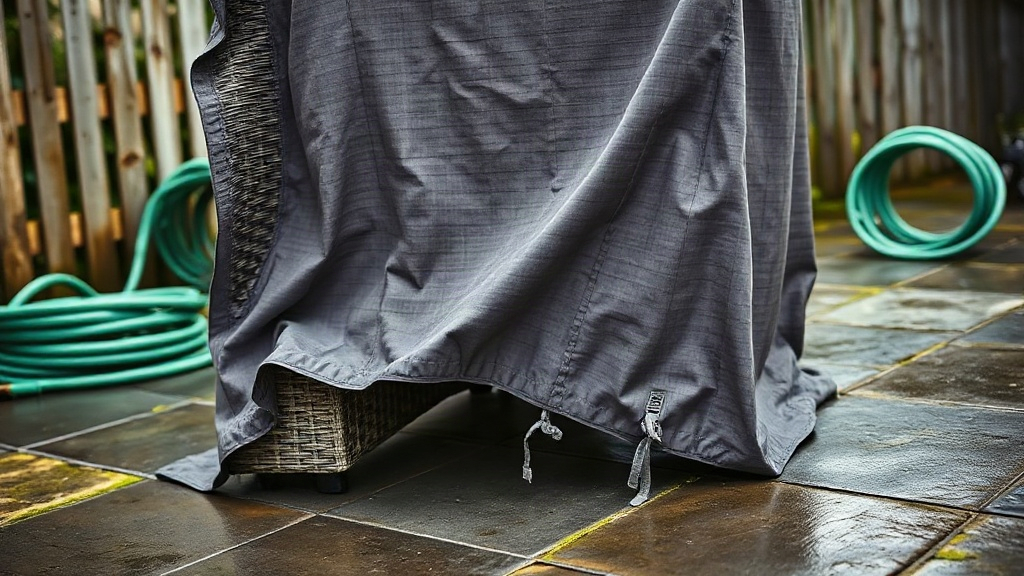
That leaves outdoor covered storage — furniture staying on the patio, protected by a breathable, waterproof cover, lifted clear of the ground, with a gap left for air to move underneath. It isn’t a compromise so much as the option that was always going to fit the largest number of UK gardens, and — done properly — it keeps furniture in genuinely good shape through to spring. The word doing the heavy lifting is breathable: a plain plastic tarp is the one choice that actively works against you, trapping condensation against the frame and creating exactly the damp, sealed conditions mould needs.
Here’s how the three compare, tarp mistake included:
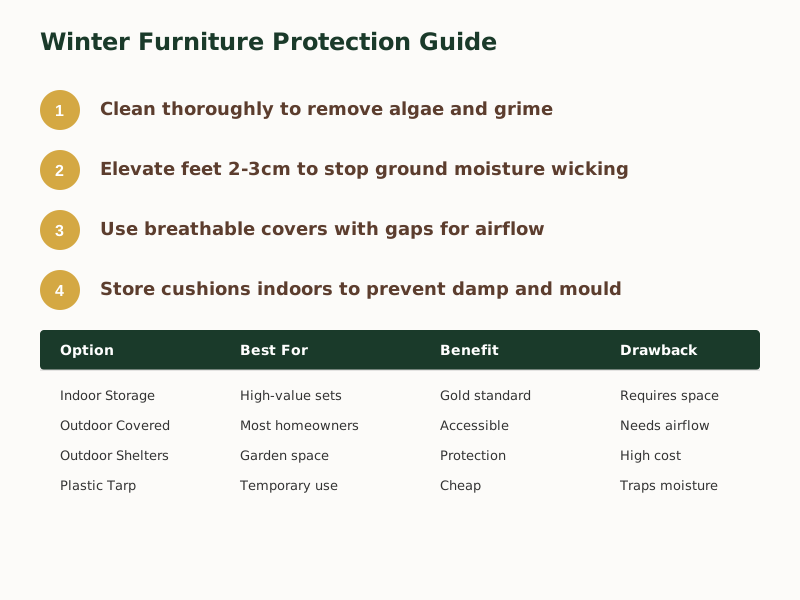
| Option | Best for | Real advantage | Where it falls down |
|---|---|---|---|
| Indoor storage | Anyone with genuine spare space | Keeps moisture off entirely | Most UK homes don’t have the room |
| Outdoor covered storage | The majority of UK gardens | Cheap, accessible, works if done right | Depends on getting the cover and airflow right |
| Outdoor shelter | Gardens with space and budget already earmarked | Real weather and snow-load protection | Hard to justify on furniture protection alone |
| Plastic tarp (not a real option) | Nobody, long-term | Cheap | Traps moisture, causes the mould it’s meant to prevent |
Before you commit to any of these, give the furniture a proper clean first. Our guide to how to clean garden furniture covers the material-by-material basics — what to use on teak versus rattan versus metal, and where a pressure washer does more harm than good.
The Step-By-Step Routine: Clean, Elevate, Cover, Cushions
For most homeowners without indoor storage, the practical winterisation is clean and dry first, then breathable cover, elevated feet, and airflow underneath. Skip any one of those four and you start creating the conditions for mould, rust, or rot.
Step 1: Clean and Dry
This is the step most people skip, and it’s the one that matters most. UK winters are wet enough that leaving debris, algae, or surface grime on the furniture and then covering it locks moisture and organic matter directly against the surface — exactly what accelerates mould. The RHS recommends cleaning garden furniture thoroughly before winter storage and ensuring it is completely dry before covering. That means giving teak sets a proper scrub, hosing down rattan to shift the green film that builds up by October, and checking underneath cushions and seat pads where grime hides.
For teak specifically, clean it in a dry spell — RHS guidance is to carry out any wood treatment in dry, well-ventilated conditions, never on damp timber. Don’t attempt to oil damp wood; it won’t absorb properly and you’ll end up with a sticky patch that attracts grit instead of repelling rain.
Step 2: Elevate Off the Ground
Ground moisture is the one nobody thinks about until the leg tips look soft and grey come spring. It wicks up through direct contact with damp soil or paving slabs — slow, but over a wet UK winter it visibly damages chair legs, table bases, and the underside of frames. The fix is straightforward: lift every piece using bricks, paving slabs, rubber furniture feet, or short timber pallets underneath each leg, enough to leave a real gap for air to move rather than just clearing the puddle line. That gap is what breaks the capillary contact drawing moisture up into the wood or metal.
Step 3: Breathe, Don’t Wrap
A breathable waterproof cover is the centrepiece of the outdoor winterisation strategy. The mechanism is simple: breathable fabric allows small amounts of moisture vapour to pass through, so any residual damp in the furniture or the air inside the cover escapes rather than condensing back onto the surface. A standard plastic tarp does the opposite — it’s genuinely waterproof, which means it also traps everything underneath it, including the moisture the furniture itself releases as it adjusts to temperature swings. Several UK care guides specifically warn against covering furniture while it’s still damp, and against using tight-fitting covers that leave no gap for air to circulate.
When you fit the cover, leave a gap at the base on at least two sides — you don’t need to seal it to the ground. Some owners tie the cover loosely around the legs or use bungee cords to keep it in place without creating an airtight cocoon. After heavy rain, it’s worth checking whether water has pooled on top of the cover; pooled water eventually finds its way through stitching, so clear it off when you can.
Step 4: Cushions Indoors
Never leave cushions on garden furniture through a UK winter. Foam fillings hold water and take days to dry from the inside, so a quick surface wipe after rain looks dry but leaves the core damp and slowly mildewing. The RHS and most UK care guides agree: cushions should come indoors to a dry space — a wardrobe, a spare room, or a sealed storage box in a garage if you have one. If you absolutely cannot bring them inside, treat them with a fabric reproofing spray first, but that’s a distant second choice.
Now you know what the process involves — get the free Garden Furniture Care Checklist to work through it step by step before the cold really sets in.
When to Consider Outdoor Shelters
If you have the garden space and the budget, a permanent outdoor shelter — a timber gazebo, a dining cabin, or a hardtop pergola — changes the winterisation equation entirely. Wood and metal gazebos offer substantially more weatherproof shelter than a cover alone, and they protect the furniture structure from snow load, which is a real concern in areas of the UK that get prolonged frosts or heavy snowfall.
The benefit isn’t just protection — it’s usability. A well-built shelter means you can still sit outside on a dry winter day without wrestling a cover off first, and some homeowners use dining cabins to extend their living space well into the autumn months.
The trade-off worth knowing is that most gazebos and shelters sold for domestic use are not designed for frequent human occupation through a UK winter. They’re not insulated, they’re not heated, and they’re not a substitute for indoor living — they’re a way to keep rain off the furniture and make the space marginally more usable in the shoulder seasons. For most readers, this level of investment is worth it only if the shelter was already on the cards for the garden anyway.
On planning permission: in England and Wales, garden gazebos and outbuildings usually fall under permitted development, but the height allowance depends on where you put it, not just how tall it is. Site a dual-pitched (gable) roof structure more than 2 metres from any boundary and it can go up to 4 metres; almost any other design is capped at 3 metres, and within 2 metres of a boundary the limit drops to 2.5 metres regardless of roof style. There’s also a 50% rule — permitted development only covers you if the shelter, plus anything else you’ve already built, doesn’t take up more than half the garden — and it can’t sit in front of the house. Scotland runs on the same broad principles but with a tighter 1-metre boundary trigger instead of 2. If you’re considering a permanent shelter, check with your local planning authority before you commit — the height limit sounds generous until you measure how close it actually is to the fence.
Product Recommendations: Covers and Protection
For covers, look specifically for breathable waterproof fabric — the kind described as “breathable polyester” or “polyester with a waterproof membrane.” Avoid non-breathable PVC tarpaulins unless you are deliberately leaving a large airflow gap underneath, which is awkward to manage in practice. A cover that’s marketed specifically as a garden furniture cover rather than a general-purpose tarp will typically have drawstrings or straps to secure it without pulling tight against the furniture.
Fabric reproofing sprays are worth considering if you have cushions that must stay outside — though the honest advice remains: bring them indoors if you possibly can. If reproofing is your only option, two products come up repeatedly in owner feedback.
Scotchgard Outdoor Water Shield (paid link) is a convenient option — it dries quickly and doesn’t change the feel of the fabric much. Owners who use it report it works well for light drizzle and splashes, though several note that it struggles in prolonged heavy rain or if the coverage is uneven. The strong chemical smell during application is a consistent complaint, so apply it in a well-ventilated space.
See current price on Amazon → (paid link)
Kiwi Camp Dry is the budget pick. It’s cheaper, widely available, and buyers on outdoor gear forums report it handles canvas, tents, and outdoor fabric effectively. The trade-off is that results can be inconsistent on older or heavily worn fabric, and the smell is — by most accounts — even stronger than Scotchgard. Both products require the fabric to be clean and dry before application, and multiple thin coats outperform one heavy coat.
Rust treatment is a step many people overlook until spring, by which point small surface rust has had months to spread under the coating. If your metal furniture has any visible rust — even a light orange bloom on a weld or chip — treat it before covering. Hammerite Kurust (paid link) is a simple brush-on option for small patches: it converts surface rust into a paint-ready black coating, applies quickly, and — going by furniture-specific reviews — holds up well for the job. The catch is that results depend heavily on prep — wire-brushing back to clean metal first makes a significant difference. It’s not a permanent structural fix, but for garden furniture maintenance it does the job well enough to get the set through winter.
Frequently Asked Questions
Can I just leave my garden furniture out in the rain?
No — not without taking steps first. Leaving furniture out uncovered through a UK winter exposes it to sustained moisture, frost, and temperature swings that accelerate mould, rust, and wood degradation. The furniture will survive, technically, but the condition it’ll be in come spring is a different story. Even the most weather-resistant materials benefit from the clean-dry-cover-elevate sequence.
Should I oil my garden furniture before winter?
If you have teak or other hardwood furniture, a clean and oil in a dry autumn spell before you cover it is genuinely worth doing. Oiled hardwood repels water more effectively than bare wood, and applying it in the right conditions — dry, not freezing, with good ventilation — means it absorbs rather than sits sticky on the surface. Our Teak Oil Guide runs through the options, from Ronseal to Rustins, with the honest trade-offs on drying time and finish. For rattan or metal furniture, oiling isn’t the relevant step — check our Rattan Furniture Repair guide for what to do instead.
As an Amazon Associate we earn from qualifying purchases. The products linked above are ones we recommend based on independent research and owner feedback.
What Actually Gets a Set Through Winter
Strip out the marketing and it comes down to four things, done in order: clean it, dry it completely, cover it with something breathable, and lift the feet off the ground. Skip the first two and the second two can’t do their job properly. None of it needs a permanent structure or a spare room — RHS guidance and the wider consensus among UK gardening writers, including Garden Organic and Which?, all land in the same place: preparation before covering matters more than the cover itself.
The genuine weak point in outdoor winterisation isn’t the cover fabric — it’s what a cover can’t reach. It protects the top and sides, not the underside, and not if it’s fitted over furniture that’s still damp. That’s the real case for elevation and airflow: they’re not extras, they’re doing the job the cover physically can’t. A set looked after this way comes out in spring in noticeably better shape than one left under a tight plastic tarp, and you don’t need a made-up price tag to know that’s worth an hour of effort in October.
Explore More Topics
Go deeper on specific topics:
- Cover vs Store vs Oil: Picking a Winter Plan for Garden Furniture
- Do Garden Furniture Covers Cause Mould? How to Prevent It
- How to Protect Garden Furniture from Rain Without Baking It in Plastic
- Best Type of Cover for a Corner Sofa Set (Fit Guide UK)
If you’re ready to work through it before the first frost, get the free Garden Furniture Care Checklist. It covers the pre-winter clean, what to check on each material type, and the cover-and-elevation basics — everything in one place, done in a spare hour on a dry weekend.